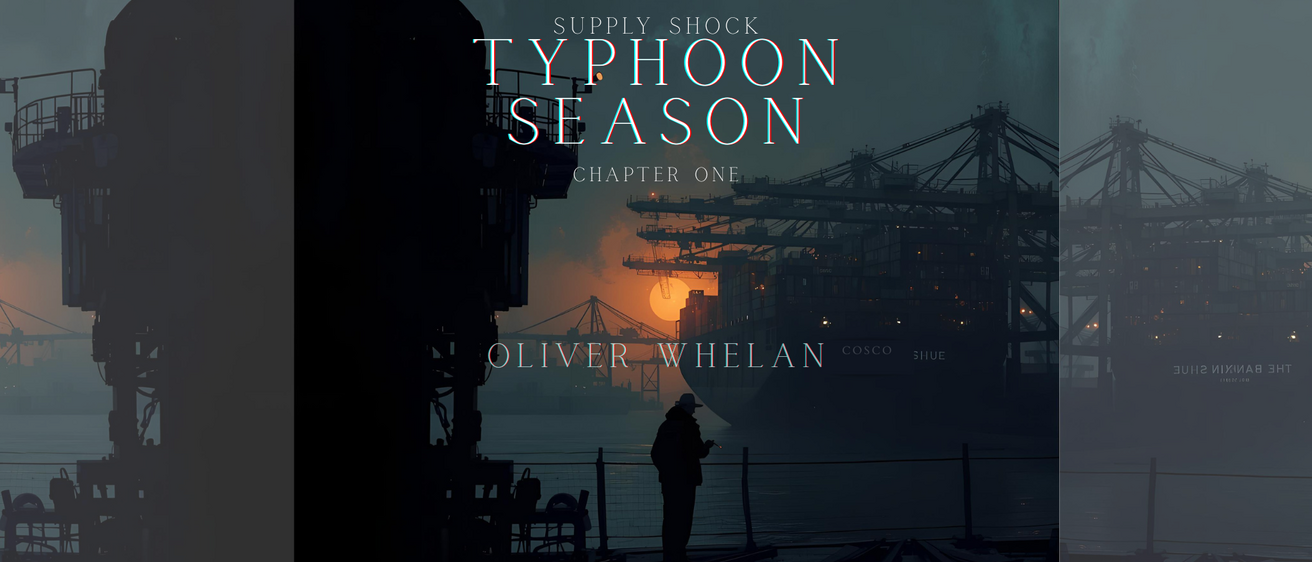
Chapter 1 - Supply Shock
PORT OF BEILUN, NINGBO-ZHOUSHAN, PEOPLE’S REPUBLIC OF CHINA
2034
The busiest port in the world never seemed to pause its unceasing noise, let alone stop it completely.
Turn one way and a visitor to the port would find themselves facing out towards Jintang Island, a distant green mass shrouded in grey by thick rain clouds which were already bringing a waft of humid, salty, dirty sea air over the port. Standing on the big docks, under the shadow of the cranes and the container ships, one could hear the sound of horns, of sea birds caterwauling and arcing and diving upon each other, of the ocean spray rushing upon the docks and of the wind whistling gently as it carried the rain closer.
Turn another way and one found themselves looking at those ships which made Ningbo-Zhoushan the biggest dot on every merchantman’s map. It seemed almost as if they were stacked end-to-end, green and white and red and blue steel monstrosities loaded with so many containers it seemed as if they must roll over. Every now and then one would begin its lumbering journey to America or Japan or Singapore or Malaysia or Ethiopia, and no sooner had it left than another would come barreling in to fill its place on the dockside, like insects picking over the corpse of an animal. The business for crane operators, tugboat drivers, harbor pilots and dockworkers was phenomenal. And so too the cacophony they added the rumble of steel on steel, the occasional screech of over-rapid movement, the shouts of commands and the clang of containers being lowered successfully into their places.
Then, of course, there was the city itself. Ningbo was one of the largest cities in China, part of the so-called Yangtze Delta Megalopolis. The light was bad enough; right now, in the early evening, the neon and LED lighting was beginning to activate, and would soon generate a vivid, eerily colorful glow over the port. But more than that, a large city at work and a busy dock created the interminable noise of hordes of cars, of airplanes flying overhead, of work being done in the harbor and of the various products that were brought in off the ships being stored, unloaded, processed and moved off to their inland destinations, only to be replaced and have the process done in reverse for outbound cargo.
And aside from the noise, there were the smells. Every kind of engine fluid imaginable melded with smog, seagull droppings, rust, grease, and the ever-present saltwater to form a cocktail that was enough to shake off one’s sea legs if they were unused to it. Less present in the center of the port was the heavy waft of petrochemicals and distillates from the refineries along the shoreline. Ningbo didn’t just “smell like the sea”, as an old sailor might have put it; it smelled like the sea in the 21st century, being put to its maximum use.
The sights, too, were indescribable to an outsider. The kaleidoscope glow of the city, the long hulls of the cargo ships scattered with a mosaic of brightly-colored containers, the rust-colored cranes trundling slowly along the pier, the choking clouds of grey smog rising into the air that was now equally filled with rain clouds, and the distant green of the islands over the concrete and brick of city streets made for a picture that was sometimes dour, sometimes comforting. To someone who was unused to it, it seemed bleak, depressing, a corporate dystopia. But someone used to its comforts would see the matter differently.
The port of Ningbo was only tolerable to someone who was there a short time, or to someone who had been there all their life. And Captain Han Jiayi was the latter.
He had always known that somehow, someday, he would end up captaining a ship. At first he had thought it would be in the navy, but a stint aboard a Type 051 destroyer in the days of Chairman Jiang had convinced him that he wasn’t cut out for it. But he had kept himself fit, kept his knowledge of the sea sharp, and had gone civilian.
COSCO Shipping was one of the world’s largest shipping companies, and they were more than happy to take on an experienced sailor. Working for a shipping company that sent cargo along every shipping lane the planet had to offer and stopped in every port bigger than a fishing harbor was a good way to get oneself a captain’s gig. And now, looking up at the bridge of the COSCO Mandalay, Han knew that he had made it.
He had arrived much earlier in the day, before the sun was even up, hoping to get a parking spot as close to the pier as possible. He had been lucky; beating the morning rush meant that his Great Wall pickup truck had plenty of space to park within a short walk from his ship. For all the things that set China apart from America, early commutes and traffic jams were not among them. He had spent that saved time getting through the menial tasks that were involved in the preparation of a massive container ship like the COSCO Mandalay for the sea. It was far from his first voyage with the ship or the crew. They were a well-oiled machine, and as the humid winds that heralded the rain swept over the pier, Han Jiayi was very glad to be sailing with them.
He took a deep drag of his cigarette and scratched idly at the greying stubble on his face. He was, truth be told, a little anxious to get out to sea. He had no loathing for his family. He had spent a lovely time on the shore with his wife and his two sons, the eldest of whom seemed keen to follow him into the navy, which was more and more of a noble career with each passing month. But he loved the sea. It was quiet, certainly quieter than Ningbo, which weighed on even the veteran ear after a while. The work of a ship was quiet in its own special way, calm and peaceful. And it was a place where he was in sync with everything, him and his crew and his ship, and skill would carry him to the other side of whatever ocean he was sent to cross.
On this particular journey, it was to be America. His ship was almost finished being loaded. From stem to stern, she was packed with containers; rare-earth metals, primarily, although there were plentiful containers to carry anything and everything imaginable. He had scanned the manifest before, but it was not first on his mind at the moment. All sixty-five thousand gross tons of the COSCO Mandalay would be filled one way or another. He was preoccupied with thoughts of tides and winds, of navigating out of the busy harbor, and of making good time to his first destination, Long Beach.
He was so preoccupied with this matter, in fact, that he did not notice his first mate, Gong Guozhi, walking up to him. Gong was a much younger man, tall and floppy-haired, and he was as skilled a subordinate as Cosco could provide.
“Captain.” As Han turned, Gong extended his hand to shake, and Han dug in his pocket for a cigarette to pass over.
“When are those crane operators going to finish?”
“They said twenty minutes forty minutes ago.”
Han snorted and waved his hand dismissively at the crane behind Gong. “What a pack of monkeys. My wife could manage a port better. We might miss the tide at this rate.”
“When it rains, it pours, Captain.”
Han nodded, taking another drag on the cigarette. Gong lit his own, smiling jovially. He began to talk, seemingly about anything that caught his fancy; the weather, his family whom he hadn’t been able to see, the things he had seen on Douyin. Unfortunately, when COSCO had seen to the matter of providing Han with a first mate, they had not selected one who matched his desire for silence and calm.
Finally, as Gong wrapped up a rambling tangent about an encounter he had in a bar in Haishu, Han turned to him.
“Get aboard. I want you to prepare the crew for our departure.”
A little chastened at the sudden dismissal, Gong nodded dutifully and began walking off towards the gangplank. Han watched him go. The dismissal had been a little brusque, but he did sometimes feel out of touch with a young man like Gong. Perhaps it was something to consider. He let the thought rest, returning his mind to the matters of bringing the ship out of Beilun.
As he did, his eyes were drawn further along the pier.
A line of black Hongqi luxury limousines was speeding along towards him. Accompanying the line were a handful of police vans, though their lights and sirens were not on.
The convoy began to slow down, and the doors of the vans slipped open. The police officers who spilled out were not anything special, but the relative calm their appearance created was immediately dispelled by the flak-jacketed members of the People’s Armed Police who bounded out after them with assault rifles slung over their chests. From behind thick sunglasses, they snapped their heads around like storks, glaring angrily at the bewildered and frightened dockhands who hurriedly backpedaled away.
The reason for their presence was suddenly explained. The wind shifted, and from his position Han could see the flags mounted near the headlights on the limousines.
The fluttering increased enough to reveal the bright red and five yellow stars of the Communist Party.
As a small gap formed in the line of police officers, the doors of the limousines were flung open by black-suited bodyguards. Out of them stepped other figures who began splitting up and walking towards several of the ships. He could see a woman rapidly approaching him, followed by two hulking bodyguards and a pair of policemen in camouflage uniforms.
He did not know what he had to fear, and so he felt at ease as she came into view. She seemed younger than him, with black hair drawn up in a tight and severe ponytail. The bodyguards behind her were constantly scanning the surroundings, but the policemen looked relaxed, hands nowhere near their weapons, and after making quick glances at him they too looked at the scenery. That too calmed him as the woman came to a stop in front of him.
“You are Han Jiayi, yes?”
A little thrown by the brusque introduction, he nodded. The Party official paused, as if sizing him up, and then turned to look at his ship.
“This is your ship, yes? The COSCO Mandalay?”
He nodded again, and she looked back at him.
“And you are sailing to Long Beach, yes?”
“Yes I am.” His first words were spoken assertively, and he felt more confident for it. There was no change in expression from her, nor did her icy and terse demeanor interrupt itself in response.
“Not anymore.”
He felt the first chill. What was going on? He could see similar conversations going on all along the pier. Other ship captains made brief gesticulations in protest, then resignedly retreated. Was there some kind of arrest being made? He hadn’t done anything wrong.
“I…I don’t understand. What do you mean?”
If the Party official heard the concern in his voice, she didn’t comment on it. She merely looked back up at the ship with an appraising eye.
“All ships carrying rare-earth metal components to America are not to set sail. The cargo is to be unloaded immediately.”
“Immediately? But…”
Her gaze bored into him. “You will be compensated for the time you would have spent at sea. Remove your crew from the vessel. If you do not comply, you will face criminal charges.”
Clearly not in a mood to delay any further, she turned on her heel and stalked back to the limousines. The bodyguards followed her immediately, with the two police officers giving him apologetic shrugs and then trailing along in tow. As his eyes followed them, they were caught by another sight.
Across the waterway between the pier and Jintang Island was the massive white hull of a Coast Guard frigate, sailing slowly along as it cast its turret accusingly in an arc along the pier. Following along with it, like a mob of little white ducklings, was a small fleet of cutters and patrol ships which now increased their speed slightly, spreading out like a web across the harbor. Their crews were not standing to their weapons, but were simply sitting back, watching the ships and making sure none made a break for the open ocean.
Han let out a long sigh, and his hand dropped again to the pack of cigarettes. He was getting old, and in his lifetime he had not seen any kind of disruption like this.
A lot of people in a lot of different places were going to be losing money because of this. The rare-earth trade was a money printer these days, and China was increasing its dominance after Myanmar collapsed into squabbling insurgent factions and Russia blasted itself into irrelevance in Ukraine. They had outsold, outmaneuvered and outlasted every other rival to become a global trade powerhouse. To turn off that firehose of money would require several very good reasons. And now, without prevarication, China had pulled its largest economic trigger.
He briefly wondered what would have caused them to do such a thing. But then he just as quickly set aside the question. That was politics, and he didn’t care for politics; it was why he’d gotten out of the navy as soon as he could. It didn’t matter why the Chairman wanted shipments to America cut, nor did it matter that as he looked out into the harbor he could see a ship he knew had been heading for America returning to port under the watchful eye of a navy helicopter.
What did matter was that, instead of spending the night in his cabin, he would spend it in his bed again. He would have to call COSCO, obviously, and report in, but then he could see his wife again. This business would all blow over soon enough, and he was already mentally filing it away as the closest he would ever get to a Party member. With any luck, they’d get a new cargo and be heading out to Long Beach within the week.
He turned abruptly, heading for the gangplank. He knew what he had to do. Find Gong, apologize for his brusqueness earlier, and tell his first mate that perhaps he was going to see his family after all.
About the Author
Oliver Whelan is an international relations student (go figure) at Michigan State University. Since elementary school he's written and never finished countless stories. If you're reading this, that might change.
Instagram: @orwhelan
Cover design made using Canva design tools.